From the Inside Out
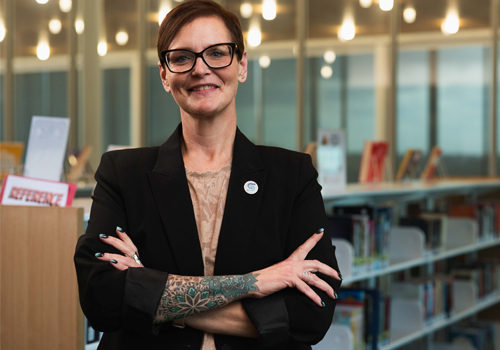
Dean Amy Doty spent 10 years in a Nebraska prison and has spent the years since teaching the system to look at people who land there the way she wishes someone had looked at her: not as the worst day of their life, but as the rest of it.
“I understand in a very real way how easily a life can be defined by trauma, adversity, poor decisions, and systems that often see people only at their worst moment,” said Doty. “I also understand the power of someone refusing to reduce a person to that moment.”
Doty’s path from incarceration to Dean of UPWARD is about what becomes possible when someone invests in you before you fully invest in yourself. Being able to take college classes while incarcerated changed her life trajectory.
“Education did not erase my past, but it changed my relationship to it,” Doty explained. “It helped me move from surviving to building. It changed how I saw myself. It allowed me to step into leadership, into service, and into a life shaped by purpose instead of limitation.”
Doty’s own experience confirms what the research suggests, which is that education is one of the most effective tools for improving post-release outcomes. The RAND meta-analysis (Davis et al., 2014) shows participation in any kind of educational program can reduce an individual’s chance of recidivism by 43%.
“When someone succeeds in college while incarcerated, it is not just about passing a course or earning a credential,” Doty said. “It is about proving to themselves they can think critically, stay committed, solve problems, and grow. For many students, this may be the first environment in a long time where they are being recognized for their potential instead of controlled for their past.”
One of the other outcomes Doty is hopeful about is a change in public perception about incarcerated individuals. She is confident this will happen once the public sees the positive impact education has on the re-entry process.
“I wish the public understood that these are not abstract issues or categories of people,” Doty said. “They are human beings with intelligence, talent, pain, potential, and often extraordinary resilience. Many of our students have survived significant trauma, instability, addiction, poverty, family disruption, and systems that failed them long before they ever entered a correctional facility.”
In just three years, Doty is making an impact on the lives of the SCC students in the Nebraska Department of Correctional Services facilities. One of those students is Jessica Whittaker, the first graduate of the program. Whittaker found a person in Doty who believed in her and challenged her to change the way she lives the rest of her life.
“Amy Doty is the most amazing person,” said Whittaker. “She told me at the very beginning she was going to help me get through this. I told her all she had to do was believe in me and I would get it done.”
As for Doty, she is going to continue to walk-the-walk and talk-the-talk as she leads SCC’s purposeful work of transforming the lives of incarcerated individuals.
“Education changed my life by giving me a way to rebuild from the inside out,” said Doty. “Most importantly, it helped me believe my story did not have to end when incarceration began. When you invest in people like me, more often than not, we show up ready to give back in impactful ways.”
Jennifer Snyder
Communications Specialist
402-323-3393
jsnyder@southeast.edu